RANDOM JOTTINGS


A blog about music, sports, theatre and rants


  • As I have mentioned previously I am wary of Austen prequels and sequels but I enjoyed Longbourn. The sub-title is Pride and Prejudice, the Servant’s Story and we are given to view the Bennett family and the ups and downs of the family through the eyes of those below stairs.

    First thing to say is that we are so used to loving Elizabeth and Jane and thinking how delightful they are and it comes as a slight shock to see them portrayed as rather careless of the feelings of their servants and how they take them for granted. I suppose this is how they were viewed in general at the time but it took me back a bit. True, they give Sarah their maid a cast off dress or two and are fond of her but they think nothing of sending her into the village in dreadful weather to purchase some rosettes for their dancing shoes which, ironically, results in her coming down with a fever and a cold similar to that suffered by Jane when she rode over to Netherfield Hall.

    Sarah is up at dawn on washday and her hands are chapped and bleeding. “If Elizabeth Bennett had the washing of her own petticoats, Sarah thought, she would be more careful not to tramp through muddy fields”. Readers of Pride and Prejudice are used to thinking of Elizabeth as active and lively and a good sister who walks to the Hall when Jane is ill, we never think of the hard work this entails at laundry time.

    The well known story of the romantic ins and outs of the Austen novel only slightly impinge on those below stairs and I found it disconcerting at first until I settled into the story. Mr Collins is dealt with in a much more sympathetic manner as a rather nervous young man unsure of himself and his reception. We
    Longare also given the hint that Mary liked him and would have married him but he chose Charlotte Lucas instead. I have long wondered why he wanted Jane and then Elizabeth when the perfect wife in the younger sister was awaiting him.

    A new manservant is taken on – one James Smith and Mr Bennett appoints him without consulting the housekeeper Mrs Hill which is unusual and her reaction alerts the reader that there is a mystery lurking which is not too difficult to solve. Sarah is very much attracted to him but he seems to be indifferent to her and wishes to remain private and keep his past history very much to himself. The family are delighted to have a handsome footman to drive them around and he takes them to the ball at the local assembly rooms where we know they first meet Darcy and Bingley:

    “It was one of those strange handicaps that afflicted gentlefolk, that they could not open a door for themselves, nor get in and out of a coach without someone to assist them……the young ladies streamed out like chicks from a hencoop, rustling gowns, each of them clasping the servant’s hand for a moment….their faces radiant with the evening”

    and then back home where Sarah is waiting for them with tea and sitting up late despite the fact she has to get up at the crack of dawn as usual.

    I found Longbourn a fascinating take on Pride and Prejudice and Jo Baker makes us look at the Austen characters in a totally different way.ย ย  We see hardly anything of Bingley, Wickham is made out to be even worse than Austen portrayed him, we feel sorry for Mrs Bennett at the contempt with which her husband treats her and Mr Darcy seems even more forbidding than he normally is:

    “He rose from his seat like a statue come to life. Sarah shrank. Fixed for the first time on her, his gaze made her dwindle to the size of a salt-cellar. He strode briskly up, stopped just a bit too close; she had to fight the urge to take a step back, to get a better angle on him, to make more space between her and his flesh”

    In the end what makes this book so interesting and so delightful, is the feeling of family between the servants. Mr and Mrs Hill have a convenient marriage with affection and friendliness for each other; Polly the young orphan girl is loved and nurtured and protected from the attentions of Wickham; Mrs HIll and Sarah have almost a mother/daughter relationship.ย  The parallel lives of those above and below stairs and their relationship is at the centre of this book and it is this which lifts it way above the usual Austen related stories that appear regularly on the market.

    .

  • … that all sequels, prequels, add ons and heaven knows what else regarding the novels of Jane Austen are poor stuff.ย  ย  And, on the whole, they are. There are exceptions however and this last week has seen me indoors, avoiding the Arctic blasts outside, re-reading two such books.

    A book of a few years ago which falls into my Approved Jane Category is Longbourn and the story is told from a servant’s point of view which makes for intriguing reading.

    It is very interesting to see how the sainted Jane and Elizabeth are viewed by those below stairs

    “If Elizabeth Bennett had the washing of her own petticoats, Sarah thought, she would be more careful not to tramp through muddy fields”.

    We are meant to admire Lizzy in her tramping across to Netherfield to see her sister and this is an outcome we do not think of.ย  I am half way through a re-read of this and will be reviewing in the next week or so.

    I admit here that though Elizabeth Bennett is regarded as a wonderful feisty character, witty and amusing etc etc I have had my doubts. She and Jane had such a close relationship that the other sisters must have felt excluded which might go some way to explain their various frailties. Mr Bennett cynical and uninterested in his family, save for Lizzy, their mother absurd and only interested in getting her daughters married, and the two elder sisters closeted together with very little interest in their siblings.ย ย 

    The Other Bennett Sister by Janice Hadlow rather proves my point. Mary is the middle of the five Bennet girls and the plainest of them all, so what hope does she have? Prim and pious, with no redeeming features, she is unloved and seemingly unlovable. As a small child she never thought she was plain, she loved her sisters and felt secure and comfortable until it was borne on her that she was the “plain one” and that her mother thought less of her because of this and her father indifferent.ย 

    The book blurb which sums this up beautifully. ย “An introvert in a family of extroverts; a constant disappointment to her mother who values beauty above all else; fearful of her fatherโ€™s sharp tongue; with little in common with her siblings โ€“ is it any wonder she turns to books for both company and guidance?”

    At the start of this title Mary is the irritating sister we all know but then we begin to see that her outer shell of superiority is a shell to cover up her inadequacies when compared to her sisters. And, as mentioned, Elizabeth and Jane are shown not to be so perfect but to be thoughtless and hurtful to the younger sibling they find annoying and do not understand.

    I have always thought that Mary was the most suitable bride for Mr Collins and in thisย  book it is made clear that she feels the same and does her best to bring this about, but is outsmarted by Charlotte Lucas as we all know.ย ย  When staying with them on a visit it is clear that the marriage is not happy and Charlotte despises her husband.ย ย  And here is where we get a new look at Mr Collins. He loves his wife but suffers knowing that she holds him in contempt.ย ย  Under the bombastic and pompous exterior is a kindly man, not the quickest wit in the world, but appreciative of his home and his family.ย ย  He and Mary spend a lot of time in the library together and slowly they form a bond.ย ย  I found this aspect of the book really most interesting and was beautifully portrayed. Charlotte begins to notice this blossoming friendship and is rather put out, but it makes her look at herself and behave more kindly to her husband and the marriage improves.

    Of course, Mary finds love in the end but it is not an easy route and, like Emma, she had to look at herself and change her thinking and admit that she too has to change her attitude.

    The author’s writing in this title is admirable. It uses the odd quotation that all Janeites will recognise but makes no attempt to pastiche her style, and she reflects the vocabulary and wit of Austen without going overboard. I think it is a really good book and thoroughly enjoyed revisiting it.

    The main reason for taking it down off my shelf was seeing a trailer of an upcoming BBC production of this book, due sometime in the next few months. Mr Bennett is played by RIchard E Grant and from the short scene that I witnessed, he is very good indeed. I am looking forward.

    And, by the way, I understand that Netflix is producing yet another Pride and Prejudice – do we really need another – and after their dire Persuasion I am not hopeful of it proving to be good. However, one thing that might make me watch is is the fact that Rufus Sewell is playing Mr Bennett…….

  • No I have not vanished and my apologies for lack of posts. As I have mentioned my daughter had to have an operation and all going well, when she had to return and have another. So my mind has been somewhat frazzled over the last two months and blogging has taken a back seat. As she got better she started going back to the gym and swimming at the beach. The day of the Bondi attack she had mentioned that she might be going and I had a panic stricken morning until she told me she was ok. In the end she had decided not to go for which I am thankful as you can imagine.

    The last few months have left me feeling a bit wobbly and the run up to Christmas and the busyness of it all did not help.

    it is Christmas morning and I will be driving to London to be with my other daughter and her family so after finishing my cup of tea and breakfast I will be loading up the car and off I go.

    All of you who have stuck with me please believe how grateful I am and I want to wish you all a wonderful Christmas wherever you are.

    thank you all x

  • This simply stunning biography was written several years ago and, having recently been embarking on a re-read of some of her novels, I decided to give this another whirl. And glad I am that I did as this in depth book gives the background and situation in her life as each book was written and gives me a new slant on the story.

    Having readย  LMM’s Journals (there are five in all) the first part of the biography was on fairly familiar ground as the author uses these as background and for illustration and ย example, but we soon come to the nitty gritty.ย ย  Did LMM write these journals with future publication in mind (yes she did) and did she therefore present herself as she wanted to be seen and not as she really was?ย  After reading The Gift of Wings I think the answer is both yes and no.ย  LMM scribbled notes when she did not have time to writer her journals and then wrote them up retrospectively, sometimes months later.ย  Of course, we all know how it is easy to represent events and happenings as we would have liked to have had them happen and I think that LMM has done the same in places.ย 

    One instance of this is her outpouring in Journal 1 which had me pinned to the sofa, about her passionate love for a Hermann Leard, which totally overwhelmed her and really awakened her sensual feelings.  She makes it very clear that she pulled back from the ‘abyss’ and did not surrender her virginity to him, much though she wanted to.  She was worried that he would think the less of her and that rumours would spread.  Also, at the time she was engaged to Edwin Simpson, an engagement which she knew was wrong and which she wanted to end.  So in the journals we learn of her love and desire for this man and how she resisted him.  What she does not mention is that he, also, was engaged to another and, therefore, how much this love was really reciprocated is left open to question.  Whatever the answer to this may be, these pages in the journals make for powerful reading and her feelings at the time were genuine and true.

    LMM herself makes the point, on re-reading her journals at a later date,  that they were the recipient of her outpourings when she was unhappy and depressed and that we were not to think that she was unhappy all the time.  Though she seems to have suffered dreadfully from a nervous state most of her life, Maud seemed to accept this knowing that she had to suffer the lows because the highs were so wonderful and that she would hate to be “phlegmatic and dull with an even temperament”.

    She wrote  “I desire that these journals never be destroyed and kept as long as the leaves hold together. I leave this to my descendants or my literary heirs as a sacred charge….there is so much of myself in these volumes that I cannot bear the thought of them ever being destroyed”

    Happy the biographer who has such material to use and Mary Henley Rubio, author of this biography, was one of the editors of the five volumes.  When they were first published, starting in 1985, readers, including a recent one, myself, felt we were on intimate terms with Maud having suffered though the pages of her life.  I found myself staggered at the frustration and torments revealed but in this biography, we find that those who still remembered her in the late 1970’s and early 1980s (as their relative, minister’s wife, their employer) knew another Maud: “an empathetic person deeply interested in others and sympathetic to them, a witty conversationalist who liked to socialise, tell stories and gossip; a lively woman who liked to attend movies discuss books and ideas and take joy in the beauty of the natural world around her”

    Maud did not marry until she was 37 and had three children in the first few years of her marriage.  Considering her age she was lucky to have two out of three survive, but her marriage was not a happy one.  Her husband, Ewan McDonald, suffered from depression which afflicted him for years.  Treatment was rather rough and ready as knowledge of this mental problem is not as sophisticated as it is now, and it would appear he was mainly treated with a series of drugs, Chloral, Nembutal, Veronal which were taken continuously.  Mary Rubio has investigated and feels that he was probably medicated into a worse position than when he first fell ill.  Maud, herself a highly nervous person with depressive tendencies, suffered bouts of the same depressive kind (these seemed to come in the winter when she was enclosed indoors because of the severe weather and unable to get out), but she was more clear sighted about these episodes and knew they came because she was not busy enough.  She was able to nurse herself through them though by the latter years of her life, stressed and worried, she was also taking large quantities of drugs which rendered her nervous and shaky.  I think that modern medical science would prove that she and Ewan, all unknowingly, had become addicted to their medication.

    Her two sons, Stewart and Chester were dearly loved but Chester turned out to be a huge disappointment to her.  He was lazy, spendthrift, obsessed with girls and sex (one episode which we read about in the book but which LMM glossed over in the journals, was the resignation of a much loved member of staff when Chester exposed himself to her), his habit of masturbation was so frequent that his brother slept in a tent in the garden rather than share a bedroom with him and as the years went by and his mother expended thousands of dollars on his lawyer training, he flunked his exams, made a rash and secret marriage when he got his girl friend pregnant and later on (fortunately after his mother’s death) he was arrested for fraud and jailed for two years. Pretty ghastly character.  No matter how much Maud tried to hide these facts from herself, she knew deep down that he was a wastrel and his much vaunted love for her was merely because he saw her as the source of comfort and money.

    Her death, when it came, was viewed as suicide.  The doctors who came to see her, after she was found dead in bed, both thought so and when her younger son Stuart, himself a doctor, arrived he was ‘motioned towards Maud’s bedside table. Dr Lane told Stuart to “take care” of the things on it and he would take care of the body. Her bedside table held some bottles and a sheet of paper’.   Her possible suicide was kept secret.  Stuart’s medical career would be damaged if his famous mother had killed herself and suicide brought a terrible stigma on the family.  The note which was left was a page numbered 176 which would appear to be a journal entry, but the other pages were missing and it was assumed that Chester took these as these covered her heartbreak over Chester and her fear of his rages.  The entry which has been taken as a suicide note is ambiguous: “My position is too awful to endure and nobody realises it. What an end to a life in which I tried always to do my best in spite of many mistakes”.

    Maud was ill when she wrote this, knowing that her life would soon be at an end and she may have just been finishing her entries for her final Journal and was summing up  her feelings at the time of writing.  Easy to feel that this might be a suicide note, but it is not clear. 

    We will probably never know and when I came to the end of this wonderful book, I felt a deep sadness for her sense of loss and sorrow.  She has given me and millions of readers so many happy hours reading her books, I still re-read them now and feel the real Maud is in her stories, and know that she had many happy times even if they were those hours she spent in writing where she could close out the harsh reality of her life and just be.

    Her journal was her saviour and her best friend and in it she wrote a latter to a future great-great- granddaughter:

    “I lived a hundred years before you did, but my blood runs in your veins and I lived and loved and suffered and enjoyed and struggled and toiled just as you do.  I found life good, in spite of everything. May you find it so.  I found that courage and kindness are the two essential things……I hope you’ll be merry and witty and brave and wise, and I hope you’ll say to yourself ‘if great-great-grandmother were alive today, I think I’d like her in spite of her faults”

    Well, I do.

  • Well another rather fraught few weeks which, hopefully, is now at an end. Firstly, my daughter in Australia had to go back to have another procedure as after her first operation a few more cells were discovered. The surgeon said that she was pretty certain they were benign but she wanted them out and, of course, that was sensible but it meant another op and recovery time. Anyway, to cut a long story short, it has been done and all is well with the second recovery.

    On top of all this I have had electrical problems which I will not bore you with but meant I did not have a working cooker for a few weeks and this all added to my stress.

    So, not much reading done. But I have read some.

    I mentioned the new Ann Cleves book and that has been read and, as always, excellent.

    Then a new book by one of my favourite crime writers, an American author, Michael Connelly. He has created a detective Harry Bosch and many novels featuring this character and all are excellent. I have read the lot over the last seven or eight years and always look forward to the next. He has allowed Harry, unlike Hercule Poirot, to age and he retires towards the later books but due to the outcry from fans, Connelly then teamed him up with a female detective, Renee Ballard and works cold cases with her. 

    But much though I love the Bosch books, I think I veer slightly towards the series The Lincoln Lawyer as just pulling ahead in the favourite stakes.  Michael Haller is Boschโ€™s half brother though they donโ€™t find this out until they are grown men and bump into each other and so we have a cross over when each of them pop up in the other series. That sounds convoluted but it makes sense believe me.

    Screenshot

    The first book in the Haller series is the Lincoln Lawyer. A movie was made with Matthew McConaughey as Haller and very good it was too. Over the last few years Netflix has made a series which is excellent. Connelly is executive producer on these and I think because of that they stick closely to the main story line. The latest one The Proving Ground kept me pinned to the sofa. A case against an A1 company, very topical, whose Bot urged a murder. Obviously been well researched and really really quite scary at the thought of what A1 can do.

    So if you wish to give these a try, please do but do read them in order if you can.

    I am also reading the latest in a series of books by an author T A Williams who I initially discovered a couple of years ago when offered one of his titles for 99p on Amazon. They were romances and I thoroughly enjoyed them. Slightly discombobulated to discover the author was not a pseudonym but was indeed a man but he seemed to be able to enter the mind and thoughts of his female protagonists very well.

    He then turned to crime and has written a series of books set in Italy, which he clearly loves as they feature in nearly all of his writing, featuring a retired DCI from Scotland yard who now lives in Italy and has a dog called Oscar.  I am reading the latest, Murder in Venice, and really liking it. I feel they can be classified as Cosy Mysteries which is a genre which true crime writers rather despise but there is nothing cosy about them. Well plotted and yes, amusing in places, but they are worth reading.

    T A Williams loves Italian food as well and the descriptions, mmmโ€ฆโ€ฆ.

    Then the latest in the Karen Pirie series by Val McDermid which I am finding increasingly irritating. A shame as she is such a good writer and I have read and enjoyed all her books to date.  The reason for my feelings is that she lets her politics come into play and cannot resist taking pot shots throughout the narrative.

    Her last book was set during the lockdown and she was quite obsessive about Covid and keeping to the rules etc. Admirable but we did not need to be told every chapter

    • She is a supporter of Nicola Sturgeon, former first Minister of Scotland now retired in disgrace. In this book many comments about the police wasting her time โ€œwith stupid questionsโ€.  (She had to resign over corruption charges)
    • She doesnโ€™t like Trump. Fair enough but leave him out of a Scottish crime novel
    • She doesnโ€™t like Nigel Farage. Again fair enough but leave him out of a Scottish crime novel
    • Kemi Badenoch, the current leader of the Tory party is called โ€œhomophobicโ€

    I used to read a series of novels about DCI Banks by Peter Robinson. They were good. OK the author used to bang on about old rock music but I used to just ignore that. Then came Brexit to which he took exception and the next books published had diatribes about it all. So I packed those in.

    I rather object to having politics thrust down my throat when I am reading a story. It is a form of conceit to feel that your readers want to know what you think. I donโ€™t. Same with โ€œCelebritiesโ€ banging on about politics. Just because you have an Oscar or a Bafta does not make you qualified to lecture the proles.

    OK stopping now because this is one of my things but you get my drift.

    So after all this crime I decided I wanted some reality so I decided to re-read a biography of L M Montgomery, she of Anne of Green Gables fame, which I read several years ago.  She had a troubled life so hardly surprising she wrote these wonderful novels for us all. Will report back.

    Signing off now.

  • Last week a friend and I went up to London and, thank goodness, this time there was no strikes in the offing so we were able to get on a bus to Trafalgar Square. From there we walked up the Mall and had grinning selfies with the Palace in the background. We were going to an exhibition at the Kingโ€™s Gallery – The Age of Elegance. It covered the Edwardian era which is a time in history I love to read about. As the title says, elegant and of course stylish and beautiful. I appreciate that if you were a scullery maid or such it was not so elegant but I still find this period of history fascinating.

    So in we went and oh my goodness, so much beauty and all fascinating. Faberge, Cartier, tiaras, pearls diamonds, we just kept going Oh Look Oh Look. Wonderful. I am putting a couple of collages on here to give you an idea of just how sumptuous it all was. And after a visit to the Gift Shop (I bought a Palace tea towel to add a touch of class to my kitchen) we walked back through James Park so beautiful in the autumn sunshine. A great day and we are back up in a week or two to the Cartier Exhibition at the Victoria & Albert and cue even more ooohing and aaahingโ€ฆ..

  • Just dropping by after my update in which I mentioned Ann Cleeves and her new book The Killing Stones. I have just finished it and it is, as always, excellent and I did not guess the murderer. I thought of somebody completely different.

    No I am here because a friend mentioned that the author was signing her book at our local book shop so natch I tore along there and though I already had a copy (the lady in charge of the shop looked a bit cross when I told her I had bought it from You Know Where) that I purchased another copy there and then. Very glad I did as this book had a lovely picture on the pages when the book was closed. The other did not.

    Well Ann arrived and was delightful and friendly and posed for pics with everyone as if it was the one thing she had wanted to do all day. So here I am

    I will be back again soon as I went to a wonderful exhibition at the King’s Gallery and have loads to say.

  • A bit late but reviewing books read last month. As my daughter has been undergoing an operation I have been worried and unable to concentrate on anything with great pith and moment but rather light reading or revisiting books so my brain did not have to work very hard.

    First up, I revisited a series of books I really enjoy by Kate Rhodes. She created a character Alice Quentin, a criminal pyschologist and there are six books in the series. I sat down one weekend and galloped through them. I can thoroughly recommend them.

    After the author finished this series she then turned to a new character Ben Kitto and a series of books set in the Scilly Isles, a place Kate Rhodes clearly loves. The latest one, Deadman’s Pool was well up to standard and I can really recommend them all. If you do start them please do read in order as the plots and characters develop over each book.

    I am also rereading Anthony Horowitz – his books featuring his detective Atticus Pund. I love this author’s writing, so clear, so elegant and such a pleasure to read. He has written three books featuring Pund, Magpie Murders, Marble Hall Murders and Moonflower Murders. They are excellent. the BBC have produced dramatisations of two of them and a third in the offing and, for once, they did not ruin the story, but stuck to the script and the result is good.

    Horowitz has also written books featuring a Scotland Yard detective Hawthorne, and I can recommend these as well. A new one coming up soon and I have preordered it.

    I have turned to Jane Austen again but this time, sequels and a writer, no longer with us sadly, produced an excellent title Mansfield Revisited in which we learn more about Edmund, Tom et al. Fanny is now married to Edmund, Aunt Norris is no more, but Julia is as obnoxious as ever. Mary Crawford, who is a really interesting character, returns and the book and plot is plausible and beautifully written. I have had it on my shelves for a long time and enjoyed reading it again.

    I then read a book by a good friend of mine, Diana Burchell, who is a true Jane lover and has written several Austen sequels etc. She is the author of Mrs Darcy’s Dilemma which lets us know what happened after Elizabeth and Mr Darcy got married and I read, for the first time, The Bride of Northanger which is a sequel to Northanger Abbey. Catherine Morland is my least favourite Austen heroine as she is incredibly silly but in this story she has married and matured and I found myself rather liking her after all.

    And then, whenever I am fed up, I turn to Georgette Heyer. I will do a post sometime on my favourites but this time I will mention Lady of Quality, one of her later book. Not her best but still delightful. Read in three hours. And, finally the new Ann Cleves, The Killing Stones. This features Jimmy Perez who is back in the Shetlands. The author announced a few years ago that she could no longer continue killing off the entire population of the Shetlands and Perez vanished over the horizon. The excellent TV series based on these books also lost the actor who played Perez, and now we have two women running the police force there. All very politically correct.

    But now he is back. Why? I can only assume that pressure was brought to bear by her publishers who have had a lot of feedback from readers. I am delighted but I do wonder what happens now if they decide to film another series with Jimmy? how will they do it?

    we shall see.

    OK so that is the round up. I have been playing around with fonts etc and hope to get the size and colour sorted soon so please bear with me if the type is large. It was looking so tiny and pale that I had to do something!

  • I said when I transferred to WordPress that I was going to try and post more regularly and already have lagged behind. I have had a pretty worrying week as my daughter, who lives in Australia, has to have an operation and, being so far away, I have been incredibly worried. However, it seems that it is all going to be straightforward so I have calmed down a bit. I have not done a huge amount of reading but have been out walking which I find a great help to clear my mind.

    Over the weekend I was in London and went for a walk in Kew Gardens one of my favourite places. My family live close by and have a membership card so can go in any time they wish so I make sure that I take advantage of this too.

    It was a glorious day as you can see and I love these September days when the sun shines and the cold has yet to set it.

    I will be back soon and have decided to do a monthly round up of my current and planned reading as I remind myself this is a book blog after all.

    So back soon and once again my thanks to all of you who have stayed with me.

    timestampe=1759664093
  • Now that the autumn is hear and the nights are drawing in I always find I turn to my great love, VIctorian Literature. In the summer I tend to read lighter books, don’t ask me why, I just do but when the leaves start to fall and the curtains are drawn against the dark, then I turn to my bookshelves.

    Some years back one visitor to Random asked what were my favourite books from that genre. I have pulled up an earlier post on this subject and have gone through it to see if there are any additions and/or alterations. On the whole my feelings remain the same so I have decided to republish it with a few minor edits.

    The book which started me off was Jane Eyre by Charlotte Bronte and this is pretty near the top of my list. We have a plain heroine who has nothing going for her but is full of determination and spunk. 

    There are times in my later readings of this novel when Jane’s determination to be a martyr has grated at times, not least when Mr Rochester wants to buy her new clothes for her wedding and she is determined to stick to her governess grey, though of course I do realise this shows her determination to be true to herself.  Her declaration of equality with Mr Rochester and the right to feel love as he does never fails to make my hair stand on end every time I read it.  The impact on Victorian women when it was published must have been stunning.  Lots of mothers would not allow their daughters to read it in case it gave them ideas.  First read when I was 11 and of course did not understand half of it, further repeated readings make me love it more and more each time.  Various film and TV versions of this book, yet to find one that I think is perfect – loved the one with Toby Stephens a couple of years ago, the sexual tension between him and his Jane leaped off the screen, but the script – too modern – rather let it down. Also there was a very silly wedding scene at the end.

    Since then I have watched others, the one with Ciaran Hinds and Samantha Morton was particularly awful but the we had the film with Michael Fassbender as Rochester, Judi Dench as Mrs Fairfax and Mia Wasikowska as Jane. I think it is well night perfect and have watched it many times. What I particularly like is that Jane has a Yorkshire accent, not broad but slight, and this made a refreshing change from earlier versions of films and TV where she has cut glass English.

    Middle March by George Eliot is one of the greatest Victorian novels ever written.  Set in the Midlands town of Middlemarch we come to know the lives, thoughts and loves of its inhabitants from the new idealistic Dr Lydgate who thinks he is going to change the world, marries a flighty beauty and gradually watches his idealism fall away, to Dorothea Brooke who marries the Reverend Causabon years older than her and then also has to see her youthful hope and idealism blighted.  I could go on for hours about the cast of characters in this superb novel but then this blog would run over into the week.  A masterpiece.  The BBC did a wonderful adaptation of it back in 1994.  Long unavailable to buy but I had an old DVD and watched it again recently and it has stood up really well .I read Adam Bede for the first time just a couple of years ago and it has come very close to replacing Middlemarch as my favourite Eliot. A trifle hard going at first, mainly because of the local dialect, but gradually this story got a hold of me and I was  unable to put it down.  The story of Adam and his love for the silly empty headed Hetty Sorrell and the ultimate terrible fate that awaits her is gripping and I sat up one night till 2 am to finish it. 

    My first Mrs Gaskell, who was a contemporary and great friend of Charlotte Bronte and one of those prolific women Victorian writers who seem to have the knack of running a home, having children and writing in their spare time, wrote many novels and the first one I read was Cranford, the story of a  village largely populated by women and maiden aunts and this book is a delightful portrayal of their daily lives and is full of small things and minutiae. The BBC dramatisation of this some years back was a smash hit and justly so as the acting was of a stratospheric standard.  With Dame Judi Dench, Dame Eileen Atkins, Sir Michael Gambon and other luminaries such as Imelda Staunton and Julia McKenzie, to mention just a few, it could hardly fail.  It is a good starter book for Mrs Gaskell but in no way reflects her grasp of the bigger issues which are portrayed in her larger, greater works such as North and South(a family move from the South to an industrial town in the north and the daughter Margaret finds it difficult to come to terms with the different way of life) until of course a dark, brooding mill owner comes along.  Wives and Daughters is a portrayal of  the search for happiness and different marriages (I think this one might be my favourite Mrs Gaskell).  She has written many others but these will keep you going.    Sir Michael Gambon produced another stunning performance as the Squire in Wives and Daughters and it was North and South which introduced us all, via the TV series, to the utter delight which is Richard Armitage. Again, I have this version bought and kept and the last scene where they meet at a railway station surely has the best kiss ever in a tv series….

    We categorise Victorian literature because of the Queen on the throne when these superb books were written but of course there are wonderful American writers of the period who also fall into this category and high on my personal list is Louisa May Alcott.When I was a young girl I adored Little Women and all the other books about the March family.  Her writing can seem somewhat moralistic in tone at times, but we have to remember when she was writing and who her audience was and there is a warmth about them which is impossible to resist.  I still weep buckets when Beth dies.

    Frances Hodgson Burnett is one of my favourite American/English authors of this period.  I have discussed The Shuttle and The Making of a Marchioness earlier on Random (I will try and locate where), She may be famous for The Little Princess and the Secret Garden but she had written many adult books and Through One Administration and T Tembaron are really great fun and immensely readable.

    I am including EF Benson in my list of Victorian Literature now as his first book Dodo was written in 1893 and  am slipping him in here as I cannot let an opportunity pass to urge anyone who has not read the Mapp and Lucia books to do so.  Some of his other stand alone works such as Michael, Mrs Ames and an Autumn Sowing show that he is not just a comedy writer. These three books show him at his best. Some of his others though are not so good but as he wrote about 90 I think he is allowed a few dodgy ones.

    Now we come to Anthony Trollope who I simply love.  There is something so reassuring about his novels. Some of them are big, fat, comfortable books which will keep you going for days, others are slimmer and lighter in content. He has also written shed loads of short stories, some of which are sooo funny.I discovered Trollope about twelve years ago and am so glad that I left it late to find this author as it meant I had many happy years of reading ahead of me and so it has proved.   The Barchester Chronicles are, of course, simply wonderful.  Barchester Towers is the one that most people remember and enjoy the most and I am not about to disagree, but by the time you reach the Last Chronicle of Barset you realise you are in the presence of a master writer.  I think it is one of his finest books telling the story of a poor and proud vicar who is accused of stealing and cashing a cheque which was not his and the events which follow. Mrs Proudie makes her presence felt and the tragedy of her marriage to the Archbishop is quite heartbreaking.    Then the Palliser novels – quite magnificent, my favourite being Phineas Finn. I am absolutely staggered at just how many books AT turned out and I have all of them on my shelves, 50+ and they will keep me going for many a year.

    But the man who towers over everyone is Charles Dickens. Worthy scholars and writers have lavished millions of words on this phenomenon so I am going to make no attempt to do so save to say that I first discovered the glory of Dickens when I was about 11 (in fact about the same time I discovered Jane Eyre so that was a good age for me).  We had a junior version of David Copperfield at school which dealt with his childhood only and finished with him finding a happy home with his aunt.  I thought that was an end to the story and was overjoyed when my English teacher told me that there was more.  I got hold of the complete book, read it, loved it and it has been one of my favourites every since.  I have to admit to problems sometimes with Dicken’s so called ‘funny’ characters who I can find irritating, and this put me off reading Pickwick Papers for a long long time as I was not drawn to the likes of Sam Weller. My mistake as when I finally read it I absolutely loved it and found myself sniggering away to myself as I read all the scrapes Mr Pickwick fell into.

    My favourite out of all his books, and it is pretty difficult to separate them out, is Bleak House, which I had to read for my A levels at school many moons ago.  Tells story of Jarndyce v Jarndyce, a case in Chancery which has been dragging on for years  and which ruins the lives of everyone it touches.  It is a work of stunning brilliance with one of the most memorable opening paragraphs in all English literature. A year or so ago I reread Great Expectations and it is now fighting for the top spot.

    The great thing about literature of this period is that there is so much out there still awaiting my attention.  In the last few years I re-read Cousin Bette by Balzac, Madame Bovary by Flaubert and discovered Zola for the first time when I read Ladies Delight in which I utterly wallowed which I suppose is FrenchVIcLit.  The American novels of this period still await me, Wharton just slips into this period by the skin of her teeth (have read everything she has written but always welcome to re-read), and then we slide effortlessly into the 1900s and 1920s onwards which also hold a fascination for me, bolstered by the publications of Persephone and the earlier Virago green editions. Then I have not even mentioned Dostoevsky or any of the Russian mob – SovLit?

    So many books and so little time.   I read and read and read and I know that when I am trying tothink of some final words of wisdom to impart to my relatives when I am about to go to the library in the sky, all I will think of is Oh bugger it I never did get round to reading War and Peace (well actually I did but I was just plucking a title out the air).……

    .

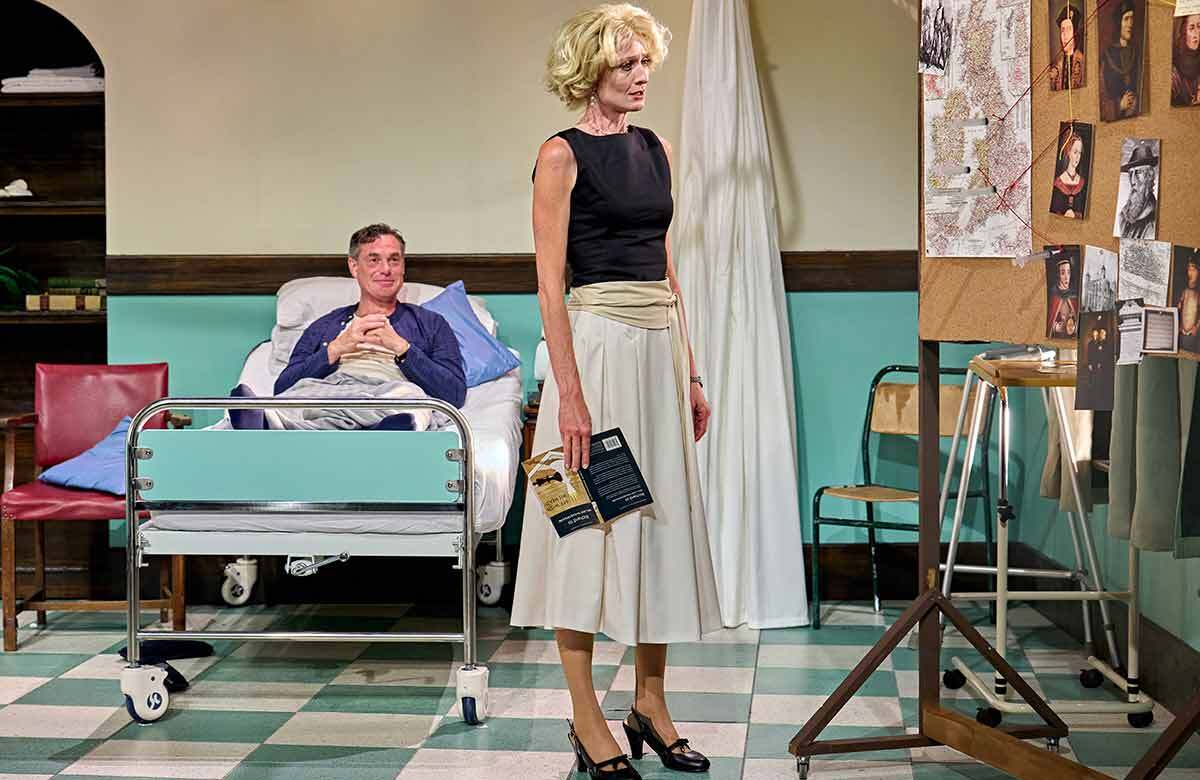
  • Last week I and a friend had arranged to go to London to the theatre to see play Daughter of Time. It was a new play and based on the book by Josephine Tey which I read many moons ago as a teenager. She had written several mystery books featuring Inspector Grant and in this particular title we find him laid up in hospital with a broken leg. He is bored and fed up and chances upon a picture of Richard III who he feels has “a rather nice face”. At the time the book was written (and the play was set in the fifties) most of us who are interested in Shakespeare had been brought up on the portrayal of Richard III by Laurence Olivier with a hunchback and an evil dark wig and sneer on his face. I accepted this characterisation until I was studying the Bard at school and it dawned on me that Will was writing plays to please a Tudor audience, including Queen Elizabeth I. Of course, we all know that Henry VII came to the throne by defeating Richard and, as he was the present Queen’s grandad, it was highly unlikely that Will wanted to offend his patron.

    Then in the sixties a historical writer, Rosemary Jarman, wrote a novel about Richard and my view of him began to change. A few years back his grave was discovered in a car park in Leicester which caused much excitement and interest in him revived. I think by now many people think he did NOT kill the Princes in the Tower so the book by Josephine Tey was well ahead of its time.

    So Inspector Grant decides to alleviate his boredom by applying his detection skills to working out a solution and this is the brunt of the book and the play. Of course, the play had to have additional material else it would all be exposition. So we had a side plot of an actress who was in love with him and Grant too obtuse to notice so she pretends to be engaged to another fellow actor to make him jealous. This actor just happened to be playing Richard III in a production so every now and then we had a cameo of his portrayal, a la Olivier.

    I am not sure the play as a whole quite worked but I found it very intriguing. I wondered how many would turn up to a matinee performance on a Wednesday but, in fact, the theatre was three quarters full and the audience was attentive.

    https://charingcrosstheatre.co.uk/theatre/the-daughter-of-time

    An interesting day which was made even more interesting by the fact that the Tube drivers were on strike so the traffic was appalling, the taxis were full and were barely moving so my friend and I, we belong to a walking group, decided to walk from Liverpool Street station to Charing Cross. A highly optimistic google map put the journey at about 40 minutes walk but I am assuming it was meant for those with youthful limbs. We set off and it took about 55 mins with a break for coffee. After the play, we had assumed that perhaps the traffic would be better. Alas no. It was just as bad only this time it was quite scary as the homegoing commuters took to bikes and it was like the Tour de France along the Embankment. Some of the two wheeled population had scant regard for pedestrians so we had to really watch our step. I had no desire to be mowed down by a Lycra clad lunatic.

    Got home, put on pjs. tea and bed.

    I slept very well indeed….

  • You know that feeling you get when you go back to school in the autumn/fall? The summer has gone and the days are drawing in and you are either returning for a fresh term or starting a new school and you have a shiny new pencil case and empty exercise books (though now they are more likely to be an ipad) and you feel that something new is starting.

    Well I am feeling that way today with Random Jottings and I am going to make more of an effort to post more than I have done hitherto. I was with Typepad for nearly twenty years (my anniversary next year) and I have to say that I felt it had got rather bogged down technically and I was finding it a bit more restrictive than it used to be. So I am not really surprised that it has closed down.

    I have used WordPress before when I was helping out with a book festival so it is not totally unfamiliar to me, but I will be spending time getting used to all its features. At the moment it is all very Noir in black and white and if I wish to have glorious technicolour I have to upgrade. Needless to say this cost money. Quelle surprise…

    So I am going to keep it basic for the time being and then one day you will click on and find that I am posting in lime green or some such. We shall see.

    I will be posting re my London visit later on this week but this is just a post to say thank you to everyone who has taken the trouble to follow me over and who have written nice comments. I really do appreciate you all and I hope to make sure that there is more content from now on. I must also thank one redoubtable new follower who is reading her way through my archive which is jogging my memory as well because each time she reads a post and likes it I receive an email telling me. I can then click on and read something I wrote yonks ago and I am enjoying re=reading them too. So my thanks. (I must say I may reuse some of the content and re=edit it as I have additions to make to some of the reviews etc)

    I am closing this introductory post to say a big thank you to my Computer Friend in New York. She has managed to do the swap over for me and, hopefully, my other typepad blogs will soon here as well. I am staggered that she could log onto my laptop in New York and sort it all out for me while I am sitting on my sofa in my pjs drinking tea while I watch and wonder.

    I thanked her profusely for all her time and her response was “Oh but it’s fun”. There is, natch, a Jane Austen quote for this :

    “One half of the world cannot understand of the pleasure of the other”…

    Back soon

  • Off to London today to the theatre. Matinee performance as do not want to stay up too late. Needless to say, this coincides with a Tube strike so I think I shall be doing a lot of walking. Hooray for the new hip! Will blog about it in a day or two

  • I am here

    if you have landed on this page HOORAY! It has been a confusing time for me and I have to tell you right away that I have a brilliant computer friend in New York and on zoom etc she has helped get Random Jottings safely here. Going to take me a while to get used to it and refine the blog but hopefully all will be well.

  • OK well here I am and it is all a bit confusing. I have already tried to post and it failed so haveing another go. Also typepad which hosts my blog seems to have vanished so hoping I can get the old blog back.

    This is another tester and let’s see if this one works

  • I have been with typepad since I started my blog nearly twenty years ago now. I have just been informed that it is now closing and after the end of September it will vanish and I will have no access to anything I have written.

    Part of me thought I would close down as I know I am intermittant in my posting these days but I do wish to hold onto everything I have written and discussed since 2006. I can have it turned into a book etc but it will be wildly bulky and expensive.

    I am therefore setting up on WordPress and am in the process of entering into a contract with them.  I have to set it all up and then export Random to them. I am hoping to retain the name.

    So over the next few weeks I will be dealing with this. Luckily I have a computer expert friend who is going to help me sort it all out and with a bit of luck I will be up and running in the next few weeks.

    I would be delighted, pleased and thankful if you will remain with me and I will post updates etc on Random on Typepad for the next few weeks.


    Elaine

  • "Sir John's satisfaction in society was much more real; he delighted in collecting about him more young people than his house would hold and the noisier they were the better he was pleased. He was a blessing to all the juvenile part of the neighbourhood for in summer he was for ever forming parties to eat cold ham and chicken out of doors, and in winter his private balls were numerous enough for any young lady who was not suffering under the insatiable appetite of fifteen"

    Yes I am reading Sense and Sensibility and the above paragraph explains my absence from Random because, as in Emma, my "engagements have increased". My daughter has been over from Australia for four months and all has been parties, banquets and balls (well, perhaps not a ball…). We did go to the seaside too though Cromer not Weymouth and nobody fell off a boat…

    While all this was going on I have been having a Janeathon and reading Austen as I could not really find the time for exploring the latest offerings by the publishing houses. Come September and when the nights draw in, I shall be settling down to my reading.

    This post is about Emma which is one of my favourite of Austen. Persuasion remains dear to my heart and always will, but I find Emma delightful. She gets everything so wrong and mucks up simply everything, and yet at the end when she realises just what mistakes she has made, she is honest to herself. I simply love her.   And after reading the book I embarked on an Emmathon and pulled up all the adaptations of Emma I could find. Here are my thoughts:

    I loved the BBC adaptation of Emma with Romola Garai but I know it garnered a mixed response, largely to do with the fact that great chunks of the script were not Jane but newly written.  I decided this week to revisit other adaptations and I sat and watched the Gwyneth Paltrow version which I have Gwyneth-paltrow-emma not viewed for some time.  What struck me straight away was just how strangulated Ms Paltrow's speaking voice sounded – while striving to sound English Upper Class she merely sounded as if she had got something stuck in her throat and this, coupled with a permanently wet look on her face, made me not  like her as much as I had hitherto.  Mr Woodhouse a bit too genial and amusing to be believable and Toni Collette not totally convincing as Harriet, but but but – yes, the thing that makes it all worthwhile, not just Jeremy Northam as Mr Knightley, gorgeous though he is – Juliet Stevenson as Mrs Elton.  Absolutely spot on.

    One thing I cannot let pass about this particular version is Ewan MacGregor as Frank Churchill, sporting a hair style which just takes your breath away in its awfulness and a reminder, for me anyway, of what a boring actor he is.

    So then I turned to a version made some ten years ago with Kate Beckinsale as the heroine.This was not available anywhere but hooray for You Tube. There it was.  She has it just about right, more matter of fact about her snobbishness and selfishness and more honest about her shortcomings.  Samantha Morton as Harriet, excellent; Bernard Hepton as Mr Woodhouse, also excellent; Prunella Scales as Miss Bates, no comment needed here on just how wonderful she was and then we have Mark Strong as Mr Knightley.  Now in real life this actor is totally bald so obviously he had to sport a full EmmaBBC1996MrKnightleyMarkStrong head of hair and I must admit I was totally fascinated by its luxuriance and the way it floated in the wind.  However, not as bad as Ewan McGregor's syrup and this actor has the most gorgeous brown eyes and when he said to Emma 'I have lectured you and you have borne it as no other woman in England' and looked at her, I sat on my sofa and went all thing…

    The only drawback of this well nigh perfect version is the Mrs Elton, played by an actress whose name escapes me (she was one of Bingley's sisters in P&P) who had the most peculiar accent which fluctuated wildly between Irish and American.  Not quite sure why.

    Some few years back I watched a version of Emma made in 1972 with Doran Goodwin as Emma and I remember her being very very good, though her Mr Knightley looked nearer 50 than 40. It was shown on BBC4 and I watched it with great interest to see if it held up, and it did.  At the same time I picked up a version of Sense and Sensibility that I remember watching yonks ago and that was pretty poor, pace so funereal you wanted to fall asleep. Also on You Tube. Here is what I said about it at the time:

    "OK, apart from the pace, which was funereal, MY DEAR the vowels, the prunes and prisms and plummy pronunciation. All too much to bear.  Everything was so beautifully modulated, the lines were spoken with a reverence suitable for a service in the local Cathedral and it was all so niminy piminy and without any life at all.  I really could not believe what I was hearing.

    The next thing I noticed was the hair, particularly those of the men.  Willoughby as befitting the cad  and  bounder had gold locks, fairly long and casual and the actor playing him looked rather like a young Rik Mayall when he was a bit gorgeous;  Edward's hair was flat and seemingly glued to his head (the actor is also totally bald now) but the best of the lot was Colonel Brandon.  Curled and pomaded and masses of it, side whiskers the lot  The last hair that fascinated me so much was that of an American actor, Cliff Robertson, in the 1970s Robert Redford movie, Three Days of the Condor (great film) where he looked like he had a back combed ferret on his head.  I could not take my eyes off Colonel Brandon in this adaptation".

    (NB – I know this post is about Emma but these comments on S&S also apply to the adaptations I have been watching – shows how TV presentation has changed)

    The latest Emma had Jonny Lee Miller as Mr Knightley with a very close crop, probably the Brutus which Em was fashionable at the time, and all the characters had much less puffed up hair than in other versions.  Even Pride and Prejudice, infinitely great in its Firthdom, has more hair than later adaptations…

    Out of the three I have seen, in the end I plump for the Kate Beckinsale  offering.  About 90% pure Jane Austen and any additional dialogue fits in beautifully and just so well done.  Of course, no surprise as this adaptation was done by none other than Andrew Davies who I think deserves to be knighted for his gift for bringing the classic to life for us all to enjoy.

    But, no matter how enjoyable and wonderful all these are in their various ways, nothing beats returning to the original text.  I know the most famous Austen opening line is 'It is a truth universally acknowledged…" and everyone knows it and it sets the scene  in one utterly perfect sentence, but read this one:

    "Miss Emma Woodhouse, handsome, clever and rich, with a comfortable home and happy disposition, seemed to unite some of the best blessings of existence; and had lived nearly twenty-one years in the world with very little to distress or vex her"

    I think this might just pip a universal truth to the post as far as I am concerned and I also admit that I might like Emma more than Elizabeth Bennett…..

    More to come on TV adaptations as I shall be watching the Winselt, Thompson, Grant, Rickman Sense and S when I have finished my read.

    PS I have not mentioned the last movie of Emma which I really disliked. Even the wonderful Bill Nighy as Mr Woodhouse could not redeem it and why the director thought it a good idea for Emma to have a nose bleed after Knightley's declaration remains one of life's great mysteries.


  • Lots of celebrations of the Divine Jane this year which, on the whole, I have avoided as any documentary or programme about her, particularly on the BBC, is 'dramatised' which entails a lot of blurry people wafting about interspersed by talking heads (all of whom are interesting) saying one sentence before we cut back to more wafting.

    Yes I know I am a misery but this kind of presenttion on the tv infuriates me and treats us as morons. So I have been returning to the books. At the moment BBC4 are showing some older Austen adaptations and I have recorded and have watched Mansfield Park, made in 1983, and though production values are a little dated, it is still wonderful and all, and I mean ALL, the dialogue is Jane, nothing added. It is still excellent and I have loved it. I then returned to the book which divides opinions and found it as absorbing as ever.

    But my favourite Jane remains the same and I
    cannot see that changing any time, and it is Persuasion. I have recorded the wonderful version with Ciaran Hinds and Amanda Root and it is, in my view, just perfect.

    Persuasion is Jane Austen's last book and it has an autumnal, elegiac, slightly melancholy feel about it.  Anne Elliot is 27 and unmarried and living at home with her vain father Sir Walter Elliot and her proud, snobbish elder sister Elizabeth.  Mary, the middle daughter who is a fussy, hypochondriac suffering from a permanent state of imagined ill usage, is married and away from home.  Anne is totally unappreciated by her family 'it is only Anne' which is a Persuasionsource of sorrow to her great friend Lady Russell who sees Anne's sterling qualities and similarity to her long dead mother.  Lady Russell exerts a strong influence on her and it is she who 'persuaded' Anne to refuse a marriage offer from Frederic Wentworth, then a lowly sailor, who she deemed not good enough for the 19 year old youngest daughter of Sir Walter.

    Sir Walter Elliot is deeply in debt and is forced to retrench and move to Bath, letting out Elliot Hall to an Admiral Coft and his wife who turns out to be sister to the long lost and loved Frederick. 

    In Bath Anne finds find her father and sister very pleased with their situation and also boasting that Mr Eliot, their father's heir, is in town and very anxious to be reunited with the family that he, purportedly, slighted many years ago.  He is charming, elegant, smooth talking and well bred and begins to pay marked attention to Anne.  It seems that he is the perfect match for her and Lady Russell, once more, tries to 'persuade' Anne that this would be a good marriage and would give her a household of her own.  Anne is not so sure and while visiting an old school friend, living in difficult circumstances in Bath, finds out certain facts that are detrimental to Mr Eliot and show him for what he is, untrustworthy and scheming. 

    Frederick is also in Bath and now deemed a much more worthy person than before by her family as he is now a Captain and rich and can thus be admitted to their social circle.  By the time Anne and Frederick see each other in Bath they have met frequently in the company of others and Anne has had to suffer in silence, noting his apparent love for Louisa Musgrove and thinking that she has lost him for ever.  A surprise engagement announcement that Louisa is marrying another gives Anne hope that perhaps all is not lost. 

    Anne has a steadfastness and quiet determination, a quality that Jane must have had in abundance and which she has passed on to all her heroines.  Eleanor in Sense and Sensibility shows this quietness and her adherance to what she knows to be the right behaviour no matter what, in total contrast to her sister Marianne who, quite frankly, I find a pain;  Fanny Price in Mansfield Park, despised as she is by all her relatives save Edward, sticks to her principles throughout and is the only protagonist not to be taken in by the Crawfords; Lizzy Bennett, on the surface much wittier and light hearted than other heroines, also has determination and the strength of character to admit she has been blinded by prejudice.  Even Catherine Morland in Northanger Abbey, who seems to be the silliest of all the Austen heroines, shows remarkable tenaciousness in clinging onto Guy Tilney after she has spotted him and wins him, despite her seeming idiocy.  These girls have all got staying power……

    Charlotte Bronte did not like Jane Austen and rather derided her style of writing, finding her passionless. This is an understandable reaction from the author of  Jane Eyre whose cry of equality to Mr Rochester must surely be one of the greatest moments in English literature, but Austen is not lacking in passion.  It is there alright but is hidden and simmering below the surface which makes the declaration of love all the more potent.

    Each time I reach the last few chapters of Persuation I am on tenterhooks and want to read on to know what is happening, even thought I have read it countless times.  Anne is in Bath, in a hotel sitting room with the Musgrove family who have come to town to buy wedding clothes for their two daughters, Louisa and Henrietta. Anne is by the window talking to an old sailor friend of Captain Wentworth, Captain Harville. He is talking to her of the pain a man feels when he says goodbye to his family on setting sail, while wondering if he will ever see them again.   Anne believes that men are capable of 'everything great and good in their married lives'  but then comes the sentence that galvanises Frederick into action 'All the privilege I claim for my own sex…………..is that of loving longest when existence or all hope is gone'

    Shortly after this Captains Wentworth and Harville depart but before Frederick leaves he gives Anne a letter and places it before her with 'eyes of glowing entreaty'.  She opens it and this is what she finds:

    "I can listen no longer in silence…….you pierce my soul. I am half agony, half hope. Tell me that I am not too late, that such precious feelings are gone for ever. I offer myself to you again with a heart even more your own that when you almost broke it eight and a half years ago. Dare not say that a man forgets sooner than woman, that his love has an earlier death. I have loved none but you…."

    No passion?

    Yeh, right.

    I closed the book last night and loved it all over again.

  • OK well I finally have a floor, pipes replaced, working water heater and lagged pipes and all is ok. I have contacted my insurance company and, as yet, no response to letter or emails so I feel another Elaine Special Letter is due to go to the CEO. I am giving them two more days before I get writing.

    So it has all been a bit of a pain and then my daughter arrived from Australia (which is NOT a pain) and it has all been a few weeks of rushing around, meeting and greeting and everything went by the board. I am just grateful that the leak etc happened before she landed.

    In the meantime I have been lucky as, in consolation for all the havoc, I have had some wonderful publications from some of my favourite authors and have loved them all. Here they are:

    Michael Connelly – Nightshade. A new series with a new detective set on Catalina Island. There is another Lincoln Lawyer on its way later this year and I gather from reading an interview with Connelly that Harry Bosch may be bidding us a farewell soon. His daughter Maddy, now in the police force, turns up in the Ballard and Bosch books so the links continue.

    Nightshade opens with a body coming to the surface in the
    harbour. Weighed down with an 2025-05-26 (2)anchor it was supposed to totally sink but the incoming tides brought it in.  Detective Stilwell is the man in charge. It goes without saying that he has been exiled to Catalina by another detective back in LA  after department politics got in the way and it also goes without saying that he has shades of Harry Bosch in his character and decides to track down the case though he is not supposed to.

    Not saying any more but it is, as always, tightly plotted and well written and the markers are there for a good long series.

    Jane Thynne – The Judgement of Stars.  I love all this author's books and while she has been writing others under a different name, and also some stand alone novels, I have been hoping that another Clara Vine book would eventually arrive. I gather I was not the only reader urging the author to give us what we wanted and here it is.

    I have reviewed Clara Vine before and the link is here so you will know that Clara is an Anglo-German actress and she meets and knows many of those in charge and is involved in spying for the British government.  I have loved all of them and this one was a sit down and read in one sitting story as I was so eager to see what had happened to Clara since the last one. If you are already a fan you will need no urging from me to read it. If you have not read any of them, then please please do so but do start from the beginning.

    Marble Hall Murders – Anthony Horowitz. A third book featuring the detective Atticus Punt and, as with the previous titles, we flit backwards and forwards in time, a device which I always enjoy. The BBC have dramatised the previous two titles and I gather this one is in the works. I am not going to give details of the plot as I have no desire to give anything away, but
    Horowitz's writing is just soooo good. He wrote the scripts for Foyles War one of my all time 2025-05-26 (3) favourite TV series (and I still wish they would bring it back) and it is sheer joy to read such elegant and witty writing. Again, you will need no urging from me to read this title if you are a fan and, if you are not,then please get hold of the first two and sit down and binge and enjoy,

    OK well I have others to write about but the fingers are getting weary so I will try and do another post with the other books I have loved in the last few weeks,

    Currently watching the tennis from Roland Garros so I might be a little bit delayed but I will return and I appreciate you bearing with me.


  • Apologies for absence but as you may guess from the title of this post I have had a mini disaster at Schloss Random.  My hallway carpet was showing stains which after being cleaned kept coming back and then I discovered that they were, oh horror, wet. My wonderful go to guy came round and ripped up the hall carpet to discover carnage underneath.

    I had a new water heater installed about eighteen months ago and the pipework was not, shall we say, one hundred per cent. A tiny tiny little leak had been slowly growing over these months and caused havoc.   The whole floor had to be taken up, skirting boards off etc. My guy sorted out the piping and then the whole floor and the storage cupboard had to be dried out. One week of humidifiers going 24/7 and then when the work was started another leak discovered and off we went again.

    To cut a long story short, I had to cancel a visit to London to be with the family and ended up over the Easter holiday feeling totally fed up. Of course the Easter eggs could not be delivered so I thought sod it and ate them myself.

    Tomorrow the flooring goes down and all will finally be finished. Then in goes the insurance claim……

    In the interim my reading has gone to pot and I have been rereading Patricia Wentworth Miss Silver mysteries which are always tremendous fun and some sloshy romances, also fun.

    I am also half way through a knitting project for my granddaughter Beatrice who is a huge Harry
    Styles fan.  Apparently he was filmed wearing a cardigan which is now being copied by fans of IMG_0153One Direction and Bea, knowing I could knit, asked if I could make it for her for her birthday.  I foolishly agreed but must admit I am thoroughly enjoying it.  Also tennis and cricket on tv at the moment so all in all I have been kept entertained though I have found the entire event stressful. I find as I get older I worry more about things…

    'sigh'

    What has kept me going is my walking group which I joined six months ago and is proving to be not only a great way of keeping fit but has introduced me to a shedload of new friends.

    Au reservoir